Increasingly, organisations are taking their first steps towards partial automation of their planning processes. This move is often driven by the desire to create a more resilient and consistent planning operation, independent of the experience of the planner on duty. Another commonly cited objective is to achieve greater driving efficiency: increasing the number of journeys and therefore revenue per deployed driver hour, or delivering higher quality and reliability with the same level of deployment.
In practice, these objectives are realistic and achievable. At the same time, the journey towards them is often underestimated. There is a tendency to assume that a planning engine is plug and play, and that optimal efficiency will be reached almost immediately.
In reality, the process works differently. Implementing a planning engine is comparable to onboarding a new human planner. There is an implementation phase during which the system must be configured, supplied with accurate data and aligned with the specific operational environment. This is followed by refinement: optimisation based on real world experience, adjustment of parameters and continuous improvement of data quality.
Only then does a situation emerge in which organisation and technology reinforce one another. Initial results are often visible straight away: greater calm within the planning team, improved predictability and the first percentage points of efficiency gain. However, as with a human planner, real growth comes through experience, guidance and structured use of data for optimisation.
At every level, insight, discipline and time are required to progressively align the operation with the way in which a planning engine functions most effectively. Technology must be aligned with people, but people must also learn to work effectively with the technology.
Across multiple projects, it became clear that this development is neither purely technical nor purely organisational. It arises from the combination of both.
Two companies, operating independently for the same client and with the same objective, reducing planning vulnerability and increasing operational efficiency, collaborated in a complementary manner.
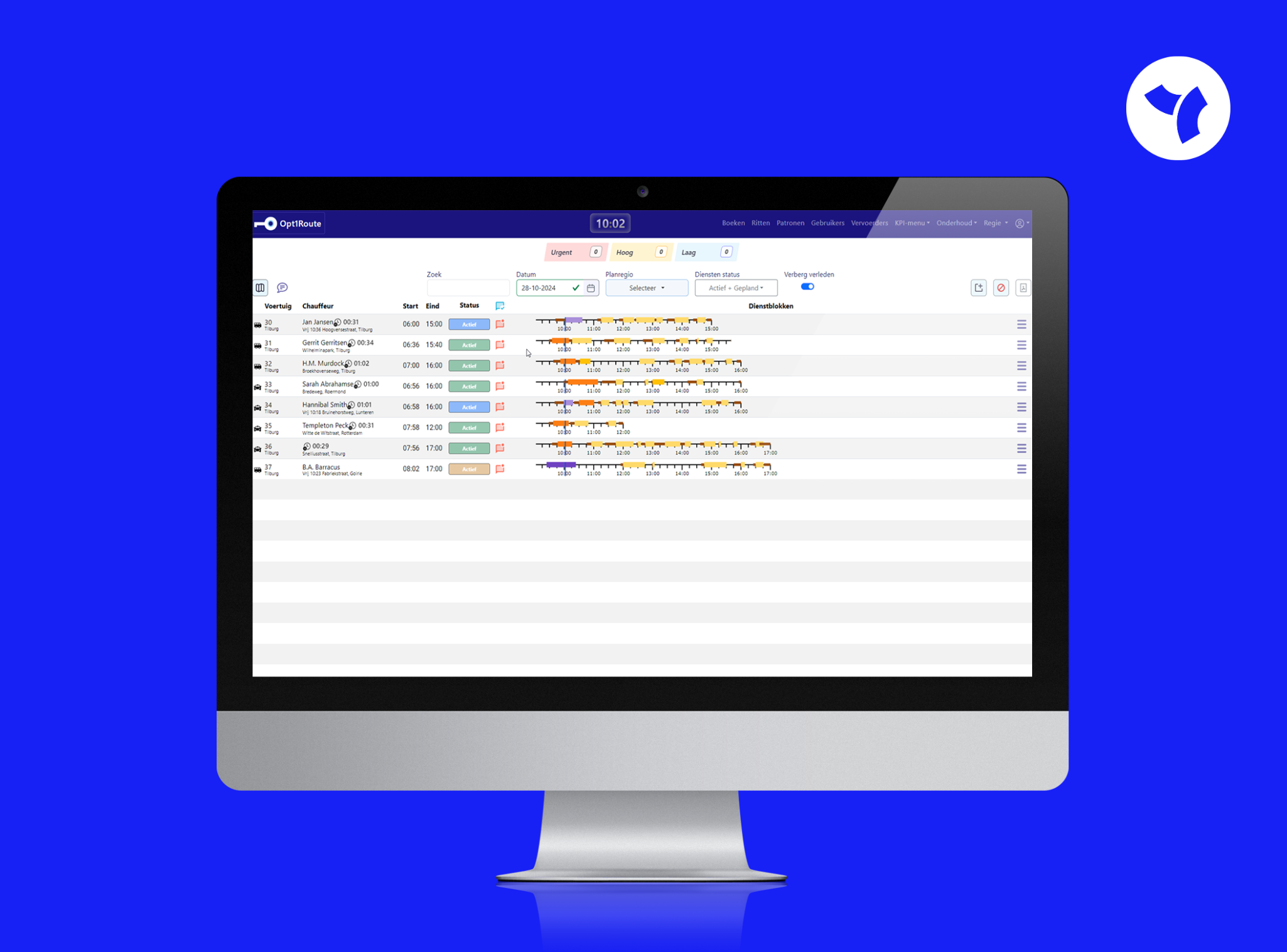
In a case study involving both a central dispatch organisation and a medium sized taxi company, the combination of the Euphoria Opt1Route planning engine delivered by Cabman and Opt1dev and targeted operational and use of data guidance provided by Schurink Consultancy resulted in a structural and measurable improvement in efficiency. Through ongoing monthly optimisation based on data insights, efficiency has steadily improved since implementation and increased by more than 10 percent within one year.
Operational Challenges
Capacity Planning
In many organisations, capacity planning has evolved historically. Duty rosters are based on experience, habits and legacy patterns, and have often not been fundamentally reviewed over time. Drivers frequently have fixed schedules from which they are reluctant to deviate. As a result, rosters are often shaped more by driver availability than by operational demand.
This can lead to daily fluctuations in the balance between supply and demand, as well as inconsistencies in the mix of vehicle types, which do not always reflect operational reality. In addition, consistent vehicle allocation is often lacking. When drivers are free to select a vehicle each day, uncertainty arises in deployment.
The planning engine is then confronted with unexpected constraints, making it more difficult to flexibly reallocate previously scheduled journeys with specific requirements, such as wheelchair transport or taxi classifications.
A consistent and predictable planning outcome requires a stable capacity foundation. This means realistic alignment between demand and supply, both in terms of hours and vehicle types, and services that are recorded accurately and in good time, with clear start and end locations, start and finish times and fixed vehicle assignments.
Journey Distribution
Contracted and target group transport is generally spread throughout the day, but characterised by clear peak periods. These peaks are difficult to cover efficiently without deploying excess capacity during quieter periods.
This creates two undesirable scenarios: either additional capacity is deployed during peak hours, or a relatively high number of journeys are delivered late within that time block, requiring overcompensation in other time slots to remain within service level agreements overall.
The greatest opportunity for improvement lies at the beginning of the process. By actively steering journey distribution during intake, peaks can be flattened. When staff have insight into demand levels per hour or quarter hour block, volume can be better aligned with available capacity.
Planner and Driver Behaviour
Planners often tend to adhere to fixed patterns and their trusted way of working, maintaining full personal control. This can result in continued manual intervention in planning outcomes. While driven by commitment and responsibility, such intervention frequently has a negative impact on overall optimisation.
A planning engine must be allowed to function as autonomously as possible, with decisions that are explainable and transparent. The system oversees the entire network and plans further ahead than any individual can. Manual corrections disrupt this broader equilibrium.
Driver behaviour also directly affects planning outcomes. When journeys are not executed in the optimal sequence, when drivers depart late or when journeys are closed off with delays, subsequent planning becomes unbalanced. The planning engine continuously recalculates; operational deviations are immediately reflected in the system.
Historically grown agreements and habits also play a role. Drivers may be accustomed to taking breaks at fixed times and fixed locations, for example at home or at a designated rank. What is perceived as an acquired right may be operationally inefficient. It can result in unnecessary empty mileage, both for the individual driver and for colleagues who temporarily have to cover the area.
It also occurs that drivers do not take breaks during quieter periods, while being unavailable during peak hours. Such inefficiencies must then be compensated with additional capacity, directly undermining the intended efficiency gains.
A Data Driven Approach to Continuous Improvement
Improvement begins with insight. Without a baseline measurement, it is impossible to determine whether adjustments have had an effect. It is important to look beyond a single key performance indicator. For example, a lower ride factor does not automatically indicate poorer performance; on certain days, average journey length may be higher, resulting in increased revenue per deployed hour.
With the right data insights, organisations can make targeted improvements, for example by:
- Optimising capacity planning by identifying days or time blocks where there is imbalance in demand, supply or vehicle type.
- Encouraging better journey distribution by providing staff with visibility of demand per quarter hour block. During booking intake, volume can be better aligned with available capacity. A customer wishing to book at 20:00, for example, could be advised of available space at 19:45 or 20:15, enabling better journey combinations.
- Monitoring performance and journey distribution per contract, enabling unprofitable contracts that place disproportionate pressure on peak capacity to be adjusted or terminated.
Making manual planner interventions transparent, allowing behavioral steering and coaching. - Measuring driver performance, both daily and over longer periods, enabling targeted action where performance consistently lags.
- Tracking deviations relating to breaks and empty mileage, reducing inefficiencies and guiding behavioural adjustments.
Based on these insights, processes can be refined and behavioural change can be systematically supported. This creates a continuous improvement cycle in which measurement, analysis and adjustment reinforce one another, structurally increasing organisational efficiency.
The intended efficiency gains are not realised through software alone, but through the combination of automation, use of data for process optimisation and targeted behavioural change.
Organisations that approach automation as a learning process, and structurally use data to continuously steer and improve performance, unlock the full potential of their planning engine and can demonstrably achieve efficiency gains of 10 percent or more.
Curious what Euphoria Opt1Route can do for your organisation? View the page here.